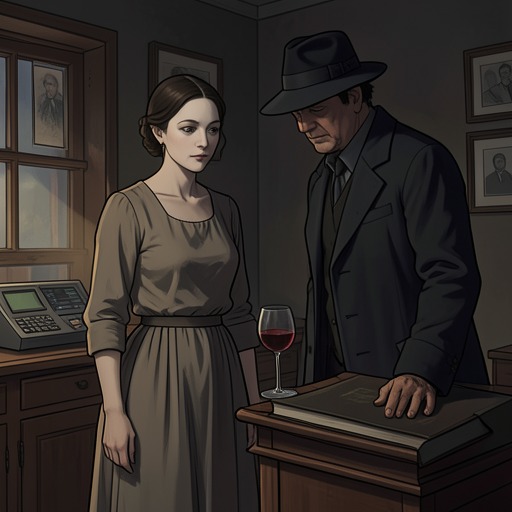
Anselmo’s Test of Camilla’s Fidelity and the Staged Proof of Her Virtue
Don QuixoteAnselmo’s Test of Camilla’s Fidelity and the Staged Proof of Her Virtue is a decisive episode in the embedded tale of Anselmo, Camilla, and Lothario. Anselmo’s wish to verify his wife’s virtue gives a hidden affair the shape of a public trial: Camilla and Lothario arrange a performance that appears to prove her fidelity, and Anselmo mistakes the appearance for truth. The episode makes his confidence feel secure at precisely the moment when his own experiment has made genuine trust impossible.
The Suspicion Behind the Test
Anselmo’s confidence in Camilla has already been compromised by his decision to have Lothario court her as a test of her virtue. When Lothario sees a man leaving Anselmo’s house at daybreak, he misreads the scene. The man is Leonela’s lover, but Lothario forgets Leonela’s existence and assumes that Camilla, who has been involved with him, must also have yielded to someone else. Jealousy, rather than careful inquiry, drives his conclusion.
Before Anselmo rises, Lothario tells him that Camilla has supposedly agreed to meet him in the closet where Anselmo keeps his jewels. The account mixes truth with deceit. Camilla and Lothario are already lovers, and she has met him there; yet Lothario presents the supposed future encounter as evidence of her imminent betrayal. He advises Anselmo not to act in haste, but to conceal himself among the tapestries and witness the meeting. The proposed test therefore offers Anselmo a spectacle to interpret, not a trustworthy way to discover the truth.
Anselmo accepts the plan. He believes that Lothario’s warning is an act of loyal friendship and agrees to hide in the closet, where he expects to see whether Camilla will confirm his fears. His decision makes him both investigator and audience: he will judge what he sees, but the people arranging the scene know what he hopes to see and can shape the evidence accordingly.
Camilla Turns Observation into Performance
Lothario later tells Camilla what he has reported to Anselmo and explains that her husband intends to hide and watch. Camilla is alarmed and angry at Lothario for creating this danger. Rather than abandon the plan or confess the affair, she devises a performance that will transform Anselmo’s concealed observation into apparent proof of her innocence. She tells Lothario to let Anselmo hide as arranged and to answer her as if he did not know that her husband was listening.
The next day Anselmo pretends to leave for a friend’s country house, then returns and conceals himself behind the tapestries. Camilla and Leonela help make his hiding possible. Once she knows he is in place, Camilla begins a scene designed for his ears as much as for Lothario. She speaks as though she has discovered Lothario’s dishonourable intentions and summons him to face her. Her words and actions present her as defending her marriage and her reputation, while Lothario plays the part required to sustain the deception.
Camilla’s performance is carefully staged around the signs Anselmo expects to read. She draws a boundary on the floor and warns Lothario not to cross it, then questions him about his friendship with Anselmo and his knowledge of her. When she appears to attack him, Lothario acts as if he must restrain her. Camilla then makes a slight wound to herself and falls as though she has fainted. The apparent danger lends weight to the scene, but its purpose is to convince the hidden observer, not to reveal what has actually happened between her and Lothario.
The False Proof and Its Cost
From behind the tapestries, Anselmo watches and listens. What he sees seems to answer his suspicions more decisively than he had expected: Camilla appears willing to defend her honour even at personal risk. He is moved by the scene and nearly comes out to embrace her and end the test, but pauses when Leonela brings Lothario back into the room. The performance holds, and Anselmo treats its appearance as confirmation rather than asking whether the evidence could have been arranged for his benefit.
Afterward, Anselmo escapes the house and seeks out Lothario. He embraces him, celebrates the apparent proof of Camilla’s purity, and praises the friend he believes has helped establish it. He also speaks of making verses that will preserve Camilla’s reputation. Lothario cannot share his happiness: he knows that Anselmo is being deceived and that his own conduct has helped create the situation. Anselmo interprets Lothario’s lack of pleasure as concern over Camilla’s slight injury, not as remorse for their affair.
The deception continues for months. Anselmo even takes Lothario home by the hand, presenting him to Camilla as the instrument of his supposed happiness. Camilla receives him without exposing the secret. Eventually the concealed guilt becomes public, and Anselmo dies as the consequence of his ill-advised curiosity. The test meant to secure his peace has instead drawn him deeper into a false account of his marriage, until the truth arrives too late to undo the damage.
Narrative Significance
The episode hinges on the difference between seeing a scene and knowing what it means. Anselmo arranges to witness Camilla, but his presence does not make the scene transparent: Camilla and Lothario know he is watching and turn his method of inquiry into a staged proof. His experiment also changes the relationships it claims merely to examine. By asking Lothario to court Camilla, Anselmo helps make his friend a participant in the betrayal; afterward, he relies on that same friend to certify the performance that conceals it.
Camilla’s resourcefulness gives her control over the immediate encounter, but the outcome is not restored trust. She and Lothario preserve their secret, while Anselmo mistakes a convincing display for moral certainty. The resulting irony is severe: he believes he has established his wife’s virtue and secured his honour, although the test has furnished only an appearance—and his faith in that appearance prolongs the deception that ultimately destroys him.